Building Executive Grit with Alicia Stajniak
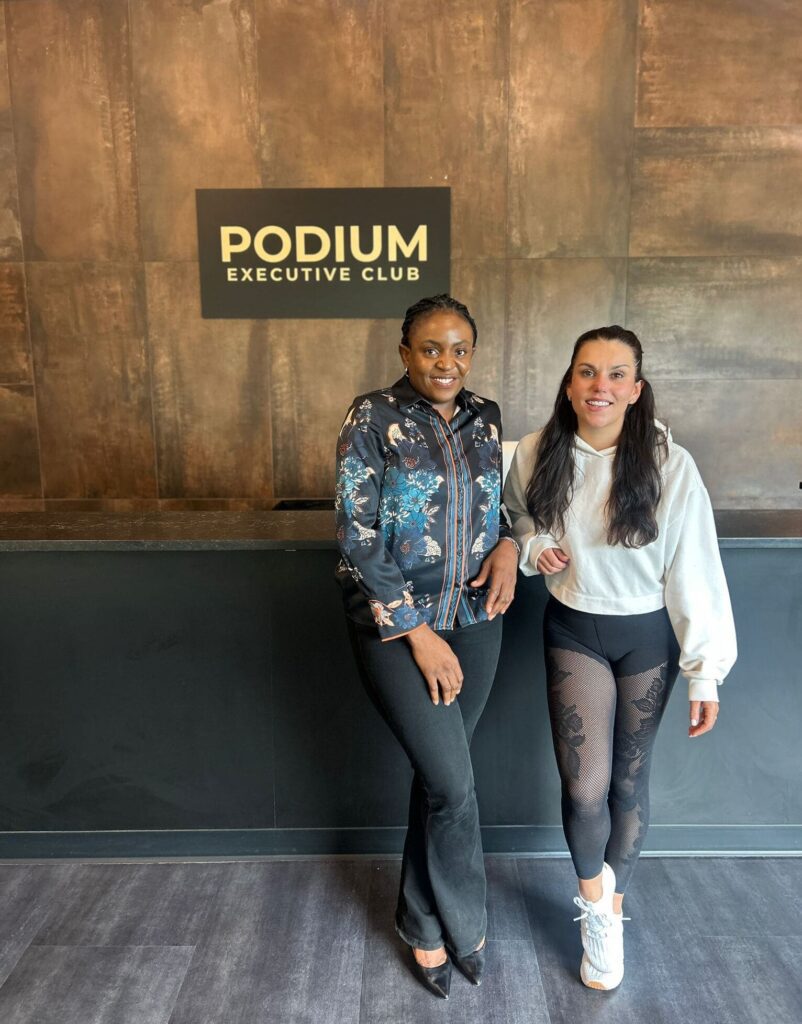
In the fall, I sat down with Alicia “Ali” Stajniak, owner of Podium Executive Club, to talk about what it really takes to build a wellness-driven business from the ground up, the lessons learned along the way, and how she’s finding balance between ambition, authenticity, and self-care. We took a tour of the space, whipped up a smoothie blend and aromatic tea and sat down to chat about her journey in business. I was delighted to steal her away from her clients for an hour to learn more about how she was able to stay inspired through the pandemic. As we settled into a quiet corner of the club, our conversation shifted quickly from surface-level updates to the real stories behind her work. I enjoyed peeling back the layers of what entrepreneurship has been for her and learning about grit through it all. Here is our conversation. Enjoy !
Q: What helps you reset and recharge in the middle of your busy entrepreneurial life?
Alicia Stajniak:
That’s a complicated one because I teach others about recovery and wellness for a living, yet I’ve struggled to apply it myself. As an entrepreneur, I wear every hat: coach, cleaner, owner, marketer. Sometimes the guilt creeps in when I take time off. I have this new entrepreneurial guilt sometimes, when I’m like, OK, it’s Friday afternoon and I’m exhausted, I just want to go home and do nothing. However, my brain does not do nothing. It keeps going. I have a really hard time shutting the guilt of “not doing enough” off.
What helps me stay sane is getting outdoors. I’m a big believer in “touching grass.” I walk my dog daily, go camping, or head to Wascana Trails to escape the city. I also love golf. It forces me to focus, which allows me to actually disconnect, and just be. And on Sundays? I try very hard to do nothing. I take a Bath, meal prep, and watch my favourite shows. Sunday is sacred, and having this one day a week is really helpful for me to step into the week ahead.
Q: Why Golf? How did that start?
Alicia Stajniak
In my early 20s, some friends introduced me to golf and I loved it immediately. Later, when I launched Podium, partnering with a golf club made perfect sense it naturally connected wellness, movement, and business. The Wascana Country Club supported the idea, and that partnership gave me access to the clientele I hoped to serve.
I started golfing for networking and fell completely in love with it.
Q: Let’s talk about Podium. Why did you start it?
Alicia Stajniak
The “why” I started and the “why” I’m still doing it are two completely different things.
When I began, it was simple: I loved wellness. I studied kinesiology and spent years in competitive powerlifting, completely immersed in the fitness world. I didn’t set out to build a business. I was just lifting, learning, and helping people in the gym who’d say, “I want to do what you’re doing.” I’d train with them for free, showing technique, helping them find their own strength. That’s where the love of coaching began: through genuine connection.
Then came an opportunity. In 2016, I was hired as a head strength and conditioning coach at a private club called 1621, which, occupied the same space that Podium is in now. I thought it was my big break. I was doing everything in that role from cleaning floors, to managing social media, bartending, training every client and I was making less than minimum wage for the hours I put in. Still, I loved it. The clients I met there changed my life; many are still with me today. I ended up needing to move on from that after about 2 years for a career that offered a little more financial opportunity for me.
When 1621 closed, the space sat empty for almost 2 years. Life moved on, and I shifted into marketing, learned how to build brands online, and fell in love with business marketing and social media. One afternoon,
while heading to a doctor’s appointment, I noticed the space again. The lights were off. The place looked abandoned. I pressed my face to the glass, and the building manager caught me looking in. He asked if I wanted to see inside and when I walked through, it hit me: this really was such a great concept.
I told my boss at the time how heartbreaking it was to see such potential wasted. He looked at me and said, “Then why don’t you do it?”
That moment changed everything. I went home, built a business plan, secured funding, and by June 2020, I’d signed a five-year lease. Construction started immediately. By October, Podium Executive Club was ready polished floors, equipment installed, energy high.
Then, one month later, the government shut everything down.
No gyms. No gatherings. No income.
I had my life savings plus investor money tied into a space no one could enter. For nearly two years, I paid rent on a virtually empty club, trying idea after idea to creatively operate the business in the space I had just sunk so much money into. It was a crazy time, the rules were constantly changing, peoples opinions were charged no matter what decisions were made, and I really couldn’t even market what I was doing without backlash, because at that time, people were being called out online just for posting photos without wearing masks, and businesses were being fined all over the city if constantly changing rules weren’t followed.
The financial and emotional toll on me personally was massive. I have never actually really spoken about this, but I don’t think I even realized until much later how hard that all was on me. Every dollar of my start-up capital disappeared into survival costs, on top of an already very isolating landscape that is being an entrepreneur.
“Those first two years were brutal. But I kept going. People walk in now and see a beautiful space and assume success. The truth? It’s been an uphill battle. But I’m still here, still showing up.”
Today, the why is no longer just about fitness. It’s about perseverance, rebuilding, and creating a community that understands that wellness isn’t only physical it’s also mental, emotional, and deeply personal.
Q: Would you say “entrepreneurship is a unique grind” is real while in it?
Alicia Stajniak
Exactly. No one tells you how many hats you’ll wear. You enter business because you love your craft, not because you’re an accountant or HR expert. I had to learn everything: leading a team, managing debt, keeping clients happy, and I did not have anyone in it with me, so I learned a lot of lessons by making a lot of mistakes.
For a long time, I hid the struggle behind “everything’s great!” But this year, I have started being more open and honest, telling people the truth when they ask. At times, I think I have been too vulnerable and I have been harshly judged for that, but also, I have found some beautiful moments where community has really shown up. People have shared their own struggles, and it’s made me feel less alone.
Q: If you could go back and advise your younger self, what would you tell her?
Alicia Stajniak
When I look back, the first thing I would tell myself is this: “build the business for the people who naturally align with you, not the people you think you need to impress”.
In the beginning, I shaped Podium around a demographic I assumed would “show up big.” At the time, a lot of the decision-makers and investors in my world were men. I convinced myself that in order to succeed, I had to cater to their interests, even though I didn’t necessarily share those interests or feel inspired by them.
Instead of creating the small studio and integrative wellness space I always envisioned, I built a business plan that was more geared to their interests. But the reality is that those same people weren’t the ones consistently coming to my classes, engaging with my content, or showing up for me personally when things got hard.
The people who did show up who rallied around me, supported the space, and became long-term clients were the people who aligned more with my interests. These were both men and women, but they are more wellness-driven, they care about connection and they value being part of a community. They were the ones who felt like home to me.
I’m careful saying this because I’m deeply grateful to everyone who has supported me in any way, including those men who encouraged me in the early stages. This isn’t about rejecting them at all, rather it’s about admitting that I didn’t trust my own instincts at the start. There was a lot of imposter syndrome. When powerful, successful men advised me, I assumed they must know best. I built a version of Podium that reflected their vision more than my own. So ya, If I could go back and tell myself something, it would be to trust my instincts, and believe in my own vision.
The second thing I would tell myself is this: “you cannot do everything alone, and you shouldn’t try.” In the beginning, I believed that I had to wear every hat until I “earned the right” to hire help. I told myself if I could just get to a certain financial milestone, that I’d be able to bring on a team to take some things off my plate and that would accelerate growth. But the truth is, I needed the team first, and that should have been my first investment.. A great accountant. A strong operations person. A marketing lead. People who are excellent at the parts I’m not. If I had invested in that support early, I would have been able to scale faster and avoid the inevitable burnout. Doing everything myself didn’t make me stronger, it slowed my growth. That’s a mistake I own.
And the third thing? I’d sit younger me down and say:
“Entrepreneurship is not glamorous. It’s lonely. It’s hard. You will lose people. and that is part of the process.”
When I started, I thought I had to please everyone. I wanted everyone to approve of what I was doing. So when people drifted, criticized, or stepped back… I took it personally. Looking back, a lot of those people weren’t meant to walk the whole journey with me. If I had understood that sooner, I would have saved myself a lot of heartache and stayed more focused on the mission, instead of the noise.
If I could speak to “Little Ali,” I’d tell her:
“You’re going to be okay.
You don’t have to shrink your ideas to make others comfortable.
Do it your way.”
And I’d remind her to give herself a little more grace along the way.
Q: How has running Podium affected your personal life? How has it changed the way you show up for the people you love?
Alicia Stajniak
It’s been a big transition for me. When I started Podium, I was 26 years old and very used to being on my own. I’ve always had lots of “good time” friends, but the circle of people I am deeply connected to has always been small. At that time I was single by choice, completely focused on work and my future, in a somewhat selfish way.
About 2 years into building Podium, I entered a serious relationship for the first time in a long time. That changed a lot for me. I am in a different stage of life now than I was at 26. I am learning lessons about how to show up for both my business in the ways it takes when you are an entrepreneur, and also within a relationship, and a family. It hasn’t been easy, I often feel like when I give more to one, I’m taking away from the other. This is something I am still figuring out, as I know a lot of people are.
And the truth is, it’s ongoing. I’m learning as I go, trying to put my energy where it’s needed most on any given day.
Q: What’s the best advice or lesson that’s carried you through?
Alicia Stajniak
Imposter syndrome is bullshit. You can do the things you think you can do. If not you, then who? If you have an idea and believe in it, you’re allowed to go for it even without experience. Even if people doubt you. Even if people don’t support you. The worst that can happen is you fail and start again.
A lot of it is conditioning being taught to stay small, stay quiet, stay unsure. We need to break out of that.
If I were speaking to a young woman starting her first business, I’d tell her this: “don’t take easy money”.Just because someone, or a certain bank, says yes to investing doesn’t mean they will automatically be the right partner for you. Choose people who align with your beliefs, and who believe in your version of your idea.
Be patient and find the people and mentors who you know will be there when things get tough. For the first time, there are so many successful women who mentor, invest, and support in a way that aligns with how we as young women think and build, which is so cool! There are many men that fit that criteria too of course! It’s just important to believe in yourself and your ideas. The right people are out there, and when you stop trying to impress others, and start being true to yourself, they find you!
Take the right money. Take your time. And trust yourself. Alicia’s story is a reminder that building something meaningful rarely follows a straight line. Her honesty about struggling, imposter syndrome, and rebuilding shows what entrepreneurship looks like behind the polished spaces and perfect photos. What stands out most is her commitment to authenticity, choosing her own voice, her own audience, and her own pace even when the world expects something different. If you’d like to learn more about Alicia’s work or experience the community she’s created, visit Podium Executive Club. It might just be the space that inspires you to redefine what strength, wellness, and leadership look like in your own life.